miércoles, noviembre 05, 2008

International dinner of erasmus in Vigo


Last thursday I was invited to a international dinner, hosted by Carolien:

Well, our international dinners were very good and very well organized when I was erasmus, but here the Internationals Relations Office... let's say they are quite lazy... to make any decent event (no, those trips of 4 or 5 hours in a city like Santiago are crap).. So this girl, a very active student :D had this great idea.
Everyone cooked something typical from where they were born in (well, I guess in some lazy cases they just bought XD)

But there was a little problem... we almost couldnt breath for a while due to sooo many people inside the flat! She told me she even didnt knew half of the ones there, and I could see many spanish (...) that I doubt they brought any food... my suspicion is that they came with their own drinks like if it was a "Botellón" inside the flat of someone... or maybe they just feel like inviting more and more friends.. it happens also often ...


Maybe if you saw some pics from any summer, you saw the parties we have here in Galicia in little towns use to finish with Queimada, that strong liquor that has to be burn first to take out some alcohol... well.. some spanish did it... inside the house..:S a bit dangerous I think, but it was ok and very didactic for foreigners XD


It was really like a rainbow of flavors... now sweet, now salty, now salad, now again salty, now greasy, now spicy... XD but I think it was a good dinner and a good time :)
Maybe it wasnt too much funny that we couldnt go to any disco they wanted to go because the security guards in Vigo dont like too many people coming at the same time in a disco... if not... they will ask if you are older than 25 or needed shoes... I know, strange, but this is Vigo... I really feel embarrased when these things happen because I think this city in the matter of going out to discos is too overestimated for too fancy and pose people... but this is another story..
Finally 4 of us escaped to the new place of rock-metal that opened few time ago, a great place, good music, good ambient, you can talk, if someone steps on you he apologizes, and even you can make new friends... the best to go out here in Vigo! :D


domingo, noviembre 02, 2008

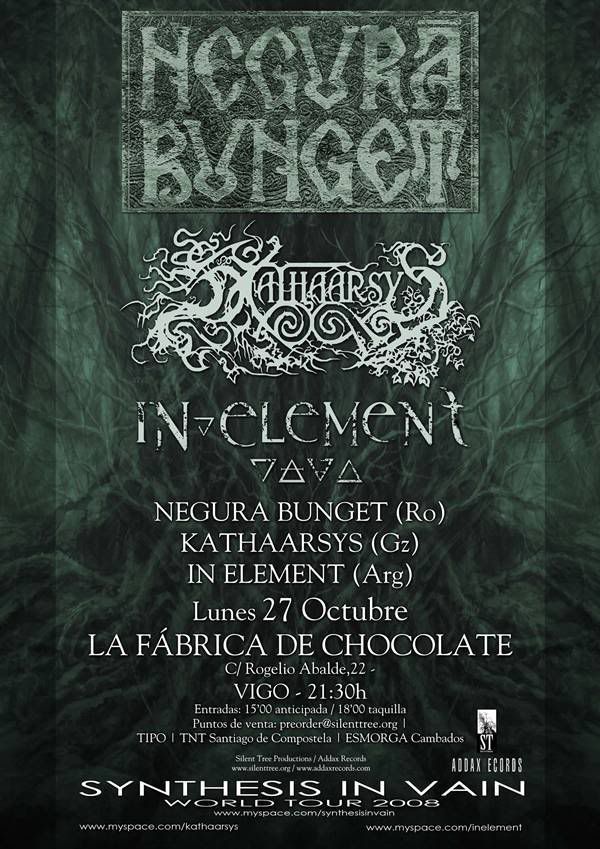
Negura Bunget + Kathaarsys + In Element concert, Vigo 2008-10-27


Bands: Negura Bunget (Rom)+ Kathaarsys (Spa) + In Element (Arg)
Place: La Fábrica de Chocolate (Vigo) - Spain
Price: 15€ (18€ entrance)

We arrived a bit late, so we missed the first band, In Element. I think it wasn't that late, but maybe the fact that it was monday made it a bit faster than usual for concerts here.
After the show we met one guy from In Element and bought him a CD so it's here ready to listen when I can (I have still loads of albums of this year to listen XD).
So, we arrived just in the starting of Kathaarsys, a great band from Galicia, maybe one of the 3 best. And probably in my top ten of the Spanish bands. They will start a big tour around the world and I guess not so many metal bands from here are able to say that.


Well, going on with the show, I saw Kathaarsys many many times, and they never disappointed me, even with bad sound they can recreate a great atmosphere. This time sound was also quite good for both bands and that helped to involve public more in their ambient.
It's amazing that just being 3 people they are making so much noise and giving so much to the audience. Everytime I watch one of their concerts I am astonished, hypnotized... I cannot look other place but the scenary... this is not happening so well when I listen to their CD at home, so I cannot explain very well what they have when playing in live... not appereance but hmm power, mystic contact, forcefulness and atmospheric moments...


The bass player has a lot of visual power and attitude, she is not stopping moving nearly never XD but their bass lines are as well quite complicated, like the kind of music they play in general. This time bass was a bit lower than guitar, but it was a not so big mistake. Drummer line is amazing... complicated, fast sometimes, joining perfectly... I think he is probably one of the best drummers we have in this land. The guy singing and playing guitar is unbeliavable, he is doing ALL the guitars, lead, rythm, clean, solos... and rythms of Kathaarsys are not characterized for their simplicity... Moreover he is singing in several tones even some clean voice.


They played few time in this concert (I guess around 1 hour) and 4 or 5 songs (yes, they are quite long XD) They played mostly about their last record Verses in Vain, but also offered a new song from their upcoming release. A good song in the "vein" of Verses in Vain, long, lots of rythm changes and maybe more variety in voice? Let's see when they launch it :P


Few public, by the way, but it also matters we were on monday, but still... somehow I was sure we wouldnt be many more if it was weekend...
Few moments of relax and Negura Bunget came.

My expectation was total about that band, I recently listened to Om, which is a good album, but couldnt imagine how they would be in concert. At first they sounded ok, but not very impressive, I'd say, but little by little we started to come inside their world... and just when 2 songs the ambient they were creating was surrounding my mind, with mystic, epic, folkie melodies, harsh moments... seemed we were being introduced into some old foggy forest in a lost part of Transilvania.. (in fact Negura Bunget means "Dark Foggy Forest", a very proper name for the style of the band). They used quite strange instruments as well, not very common for Metal bands but really effective for recreating such a dark-epic-folk surrounding atmosphere.
Pan flute, flute, xylophone, kettledrum, and even one piece of wood that they played with 2 small wood hammers!! I have never seen before someone playing .. hm with a plank, even couldnt imagine XD


Worth mentioning the huge horn the singer took, maybe 3 meters!!!

Cannot say too much about the songs because I couldn't understand any song names since they sang in romanian... but the matter is that the environment, the ambient was great, good songs, atmospheric sometimes, folkie or raw and angry others... with a good taste in the changes, I simply enjoyed a lot their show.
Sound was in general ok for both bands, and people were few as usual in these concerts, more even being monday, but it was really worth.


I took a pic with the singer of Negura Bunget that you can see down here, he was really sooooo polite and this is something really strange to see in metal bands that it was almost funny, like everytime... thanks, sorry, could you make lower the sound of.. thank you very much ... sorry.. XDD

We recalled when seeing him sometimes a famous cartoon character in Spain lots of years ago... Ulises 31 :D

Worth also mentioning when Kathaarsys were playing there were 2 or 3 guys making headbanging as none, first thing I thought... "huh!? they are not from here!!XDD" they were people from Negura Bunget!! :)
So hail to Negura Bunget and good luck for Kathaarsys in the world tour! Sure they will find more warm ambient abroad Spain and Galicia!


Negura Bunget - Bruiestru

sábado, noviembre 01, 2008

Halloween history and tradition


Halloween's origins date back to the ancient Celtic festival of Samhain (pronounced sow-in).

The Celts, who lived 2,000 years ago in the area that is now Ireland, the United Kingdom, and northern France, celebrated their new year on November 1. This day marked the end of summer and the harvest and the beginning of the dark, cold winter, a time of year that was often associated with human death. Celts believed that on the night before the new year, the boundary between the worlds of the living and the dead became blurred. On the night of October 31, they celebrated Samhain, when it was believed that the ghosts of the dead returned to earth. In addition to causing trouble and damaging crops, Celts thought that the presence of the otherworldly spirits made it easier for the Druids, or Celtic priests, to make predictions about the future. For a people entirely dependent on the volatile natural world, these prophecies were an important source of comfort and direction during the long, dark winter.

To commemorate the event, Druids built huge sacred bonfires, where the people gathered to burn crops and animals as sacrifices to the Celtic deities.

During the celebration, the Celts wore costumes, typically consisting of animal heads and skins, and attempted to tell each other's fortunes. When the celebration was over, they re-lit their hearth fires, which they had extinguished earlier that evening, from the sacred bonfire to help protect them during the coming winter.

By A.D. 43, Romans had conquered the majority of Celtic territory. In the course of the four hundred years that they ruled the Celtic lands, two festivals of Roman origin were combined with the traditional Celtic celebration of Samhain.

The first was Feralia, a day in late October when the Romans traditionally commemorated the passing of the dead. The second was a day to honor Pomona, the Roman goddess of fruit and trees. The symbol of Pomona is the apple and the incorporation of this celebration into Samhain probably explains the tradition of "bobbing" for apples that is practiced today on Halloween.

By the 800s, the influence of Christianity had spread into Celtic lands. In the seventh century, Pope Boniface IV designated November 1 All Saints' Day, a time to honor saints and martyrs. It is widely believed today that the pope was attempting to replace the Celtic festival of the dead with a related, but church-sanctioned holiday. The celebration was also called All-hallows or All-hallowmas (from Middle English Alholowmesse meaning All Saints' Day) and the night before it, the night of Samhain, began to be called All-hallows Eve and, eventually, Halloween. Even later, in A.D. 1000, the church would make November 2 All Souls' Day, a day to honor the dead. It was celebrated similarly to Samhain, with big bonfires, parades, and dressing up in costumes as saints, angels, and devils. Together, the three celebrations, the eve of All Saints', All Saints', and All Souls', were called Hallowmas.

As European immigrants came to America, they brought their varied Halloween customs with them. Because of the rigid Protestant belief systems that characterized early New England, celebration of Halloween in colonial times was extremely limited there.

It was much more common in Maryland and the southern colonies. As the beliefs and customs of different European ethnic groups, as well as the American Indians, meshed, a distinctly American version of Halloween began to emerge. The first celebrations included "play parties," public events held to celebrate the harvest, where neighbors would share stories of the dead, tell each other's fortunes, dance, and sing. Colonial Halloween festivities also featured the telling of ghost stories and mischief-making of all kinds. By the middle of the nineteenth century, annual autumn festivities were common, but Halloween was not yet celebrated everywhere in the country.

In the second half of the nineteenth century, America was flooded with new immigrants. These new immigrants, especially the millions of Irish fleeing Ireland's potato famine of 1846, helped to popularize the celebration of Halloween nationally. Taking from Irish and English traditions, Americans began to dress up in costumes and go house to house asking for food or money, a practice that eventually became today's "trick-or-treat" tradition. Young women believed that, on Halloween, they could divine the name or appearance of their future husband by doing tricks with yarn, apple parings, or mirrors.

In the late 1800s, there was a move in America to mold Halloween into a holiday more about community and neighborly get-togethers, than about ghosts, pranks, and witchcraft.

At the turn of the century, Halloween parties for both children and adults became the most common way to celebrate the day. Parties focused on games, foods of the season, and festive costumes. Parents were encouraged by newspapers and community leaders to take anything "frightening" or "grotesque" out of Halloween celebrations. Because of their efforts, Halloween lost most of its superstitious and religious overtones by the beginning of the twentieth century.

By the 1920s and 1930s, Halloween had become a secular, but community-centered holiday, with parades and town-wide parties as the featured entertainment. Despite the best efforts of many schools and communities, vandalism began to plague Halloween celebrations in many communities during this time. By the 1950s, town leaders had successfully limited vandalism and Halloween had evolved into a holiday directed mainly at the young. Due to the high numbers of young children during the fifties baby boom, parties moved from town civic centers into the classroom or home, where they could be more easily accommodated. Between 1920 and 1950, the centuries-old practice of trick-or-treating was also revived. Trick-or-treating was a relatively inexpensive way for an entire community to share the Halloween celebration. In theory, families could also prevent tricks being played on them by providing the neighborhood children with small treats. A new American tradition was born, and it has continued to grow. Today, Americans spend an estimated $6.9 billion annually on Halloween, making it the country's second largest commercial holiday.

Source:

http://www.history.com/

martes, octubre 28, 2008

Tapas night


Last thursday I went with Mark, the student from Estonia to have some drink and tapas in some place. I know some few places for tapas in Vigo, but they are very few... and when it's weekend or near weekend these few places are completely full of people.
Definitely Vigo is the worst place in Galicia for going out to have some wine with tapas.
Mark came with some friends and we went to the main place erasmus students used to gather last year, called Orensano. It was surprisingly full, and we couldnt almost to step inside :S, so we decided to change to another one... Brasil. It was also full but we decided to wait a bit, because we already walked a lot and we couldn't say certainty other place wouldn't be full.
Finally we got a table and asked for some food (tapas should be usually free, but we decided to taste different things and it was the fastest way)...


Churrasco and zorza (different ways of pork, quite typical from Galicia)


Calamares (squids) (like Kracken but smaller XDD)

(Remains of) pulpo (octopus)


Of course finishing with Coffe Liquor! (or Crema de orujo -if you like Baileys you would like it-)


And afterwards the same of every party night... Botellón XDD (yes, here it is allowed to drink in the street, almost a tradition) and after that some pub or disco... one typical night of tapas in Galicia XD